Skip to content
Join the Academy today. Start out in combat sports.MMA, Brazilian jiu-jitsu and classes for children.Three levels, from the beginner group to the competitive one.Group classes from Monday to Friday.Wilanów, Wiertnicza 26A.
A combat sports academy in Wilanów, Warsaw. MMA and Brazilian jiu-jitsu for adults, plus classes for children.

For parents

Before you sign your child up

We answer the questions we hear most often. Including when the honest answer is “it depends”.

What your child practises on the mat

Three things that make up a session

  • Control of the body

    Coordination, balance, deliberate movement and control of force. The child learns how much force a given movement needs, and how to fall safely.

  • Working with a partner

    Drills are done with a partner, which means responsibility for another person. The agreed signal ends a drill immediately, with no discussion.

  • Regularity

    Progress comes from repetition and from gradually increasing difficulty. That is the part you only see after a few months.

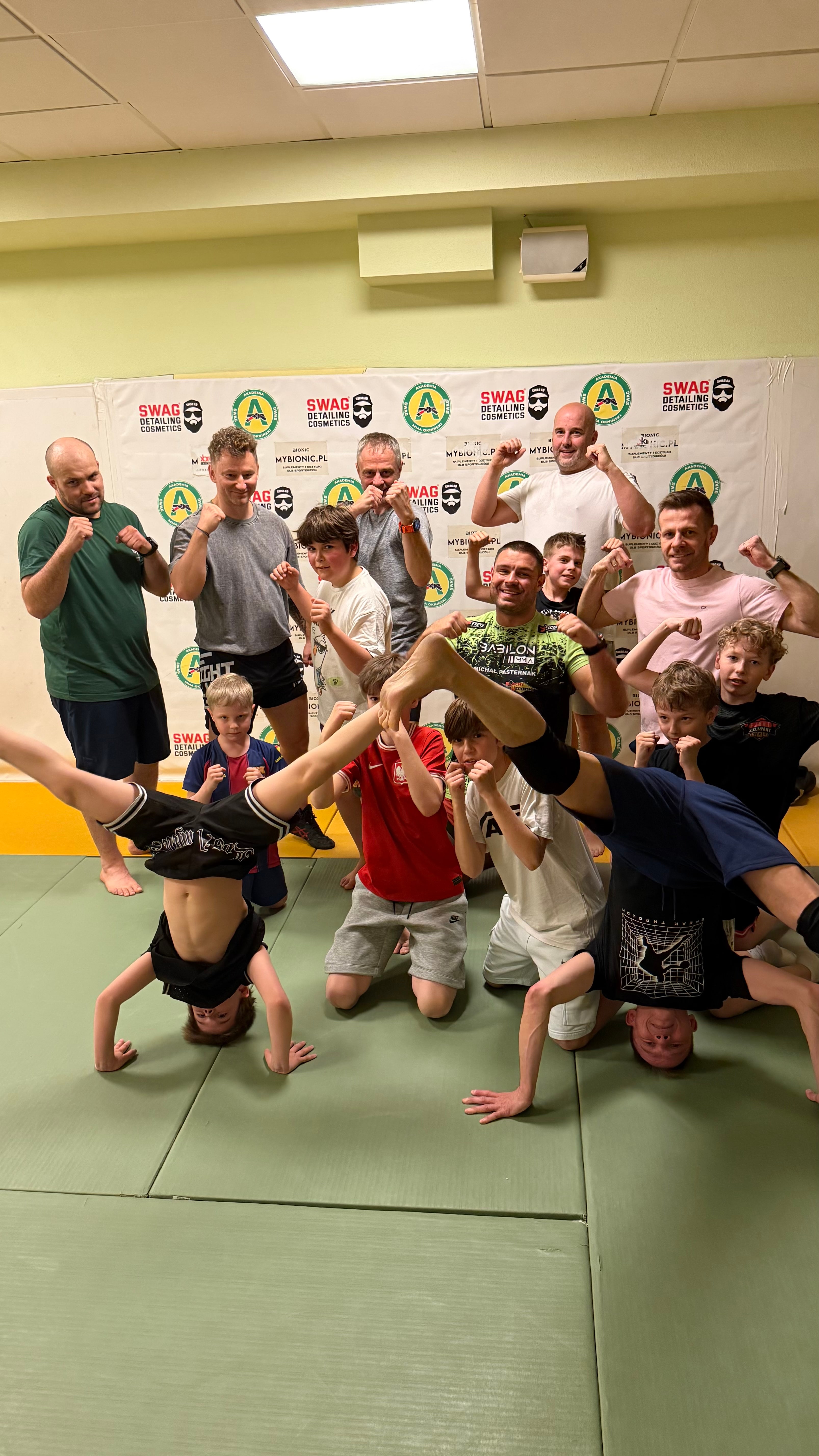
Adults and children posing together on the mat in front of the Academy banner, some standing on their heads
A father and son session

Questions

Common questions

  • Does my child need previous experience?

    No. The beginner group is meant for children who have had no previous contact with combat sports.

    There is also no fitness threshold to start from. Condition is a result of training, not a condition of walking into the room.

  • What does a session consist of?

    A class usually includes physical preparation, learning and repeating technique, work in pairs, coordination drills and movement tasks matched to the group.

    The balance between these changes with age, level and what the group is currently working on. We do not run classes to a rigid minute by minute plan.

  • Is it safe?

    Combat sports are a contact sport and carry a risk of injury. We are not going to claim otherwise.

    What we do control is how the classes are run. The level is matched to the group, beginners do not land among advanced trainees straight away, and intensity rises gradually. Drills are done under the coach's supervision.

    In recreational training there is no need to take part in full sparring. Competing and preparing as a fighter is a separate decision that requires the coach's agreement. Anyone preparing for a bout does in time need controlled sparring appropriate to their level.

  • How do you choose the group?

    We look at age and experience, so that children work with partners of similar ability. The coach decides after seeing the child in a session, not from the date of birth alone.

  • Will my child have to compete?

    No. Competing is decided by the child's readiness and a conversation with the coach. The Academy is a sports club and prepares for competition those children who want to compete, but it does not push anyone into it.

  • What does my child need for the first session?

    Comfortable sports clothing, flip flops for moving around off the mat and a water bottle with their name on it. Nothing else is needed to start.

    Specialist equipment is bought only once the child decides they want to carry on training.

  • Can I stay and watch?

    Talk to the coach before the first class. The coach decides, taking into account the child's comfort, the group's focus and how the session is organised.

What regular training gives a child

Regular physical activity and combat sports training can support a child's development. Research points to a positive effect of martial arts programmes on coordination, balance, strength, flexibility, speed and endurance.

On top of that comes what you see in the room: general physical competence, working with a partner, respecting agreed rules, and the regularity and patience without which there is no progress in this sport.

Researchers are careful about this and so will we be. A 2026 review states plainly that martial arts training cannot be treated as something that lowers aggression on its own. Results differ depending on the discipline, the way sessions are run and the person running them.

That matches what we see in the training room. The difference is made not by the sport itself but by how the work is done: the order of exercises, how a coach reacts to what a child does, and consistency in holding to the rules.

We do not promise medical or therapeutic effects. Contact training always carries a risk of injury and we are not going to claim otherwise.

See the sources
ClassesWhatsApp, opens in a new tabCall